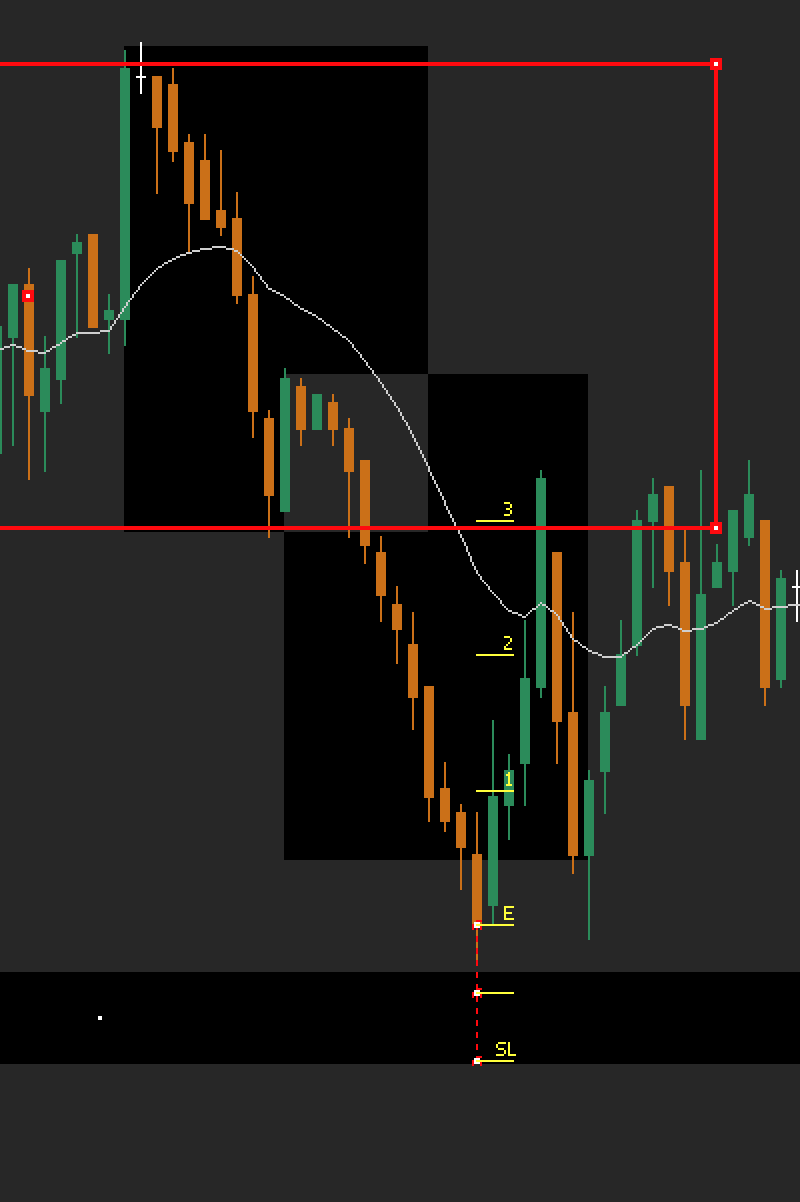
Trend Reversal / Exhaustion Strategy
This strategy is designed to identify major trend reversals, specifically when the overall movement of the market is about to change direction. For instance, it can be applied when a downward trend is transitioning into an upward trend, or vice versa. This is not intended for minor fluctuations, but for significant trend shifts.
1. Market Analysis
Critical market analysis is essential. Before considering a trade, the market must be evaluated to confirm that the current trend and leg structure allow for a potential reversal.
2. Measuring the Legs
Begin by measuring the legs of the ongoing movement. This strategy becomes relevant toward the end of the second or third leg. Identify the break-even point, which generally coincides with or is near the end of the leg.
3. Sequence of Price Action
The typical sequence for this setup is as follows:
Trend Continuation: Price continues in the direction of the current trend.
Exhaustion Candle: A full-body candle forms near the end of the leg, representing the final push in the direction of the trend. This candle may be deceptive, appearing strong but actually signaling exhaustion. It often has a shadow pointing opposite the forthcoming reversal. Occasionally, it may extend beyond the leg; this is acceptable as long as it does not create a new leg.
Break-Even Point: Price reaches the break-even point, which often acts as a pivot for the reversal.
Trend Reversal: After touching the break-even point, price reverses, initiating a new movement in the opposite direction of the original trend.
4. Entry and Stop Loss
Entry: A trade may be entered approximately midway through the break-even point, at the stage where the reversal begins to develop. Alternatively, if the candle just touches the breakeven point, entry is the lowest point of the candle. Unlike every other strategy, in this one it is ok to enter without waiting for a close.
Stop Loss: Place the stop-loss behind the break-even point and behind two reactive surfaces (e.g., supports or resistances). This ensures sufficient cushioning in case price temporarily moves against the trade before fully reversing.
Take Profit: The movement can typically be held until it reaches the moving average, which often coincides with the second take-profit level, particularly in Gold (XAUUSD).
5. Risk and Reward
Reward: High, as this strategy captures the early stage of a new trend.
Risk: Higher than other strategies, because the trade is entered against the existing trend.
6. Additional Considerations
Occasional extension of the exhaustion candle beyond the leg is acceptable, as long as it does not form a new leg.
Failures generally occur due to inadequate stop-loss placement, not because the reversal signal is invalid.
This setup is inherently more complex and riskier than other strategies, but it offers significant reward potential when executed properly.